
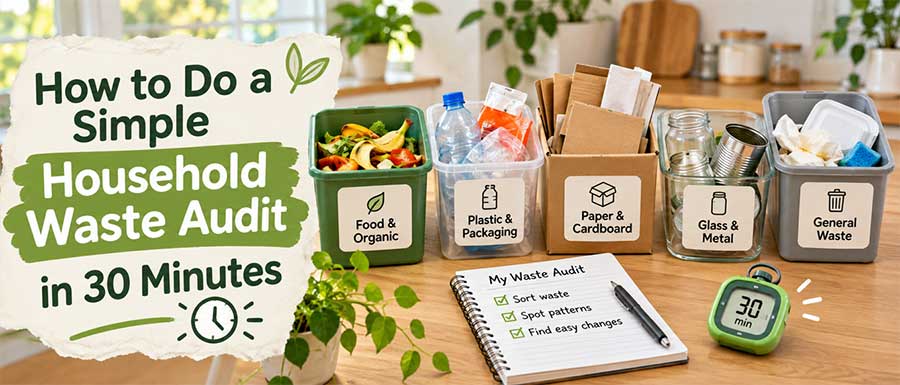
How to Do a Simple Household Waste Audit in 30 Minutes
Have you ever emptied your kitchen bin and wondered how much of that rubbish could have been avoided? Perhaps it’s vegetable scraps from preparing dinner, plastic packaging from your weekly shopping, empty bottles or takeaway containers from a busy day.
Most households produce a mixture of waste every day. We throw things away, replace them and get on with our routines without giving much thought to what actually ends up in the bin. But when you take a closer look, you may notice a few habits that could easily be changed.
That’s where a household waste audit can help.
A waste audit doesn’t have to involve complicated measurements, expensive equipment or a detailed environmental assessment. You can start with a simple 30-minute exercise using a few containers and a notebook. The aim is to understand what your household throws away most often and identify practical ways to reduce it.
Whether you’re trying to cut down on plastic packaging, make better use of groceries or simply keep your home a little less wasteful, this is a useful place to begin.
Here’s how to do it.
What Is a Household Waste Audit?
A household waste audit is simply a closer look at the rubbish your home produces. It involves sorting and examining different types of waste to understand where they come from and whether some of them could be avoided.
For example, you might discover that your household regularly throws away:
- Fruit and vegetable scraps from meal preparation.
- Plastic wrappers and packaging from groceries.
- Empty water bottles and drink containers.
- Cardboard boxes from online deliveries.
- Leftover food that wasn’t eaten.
- Paper products and disposable household items.
Looking at these items together can reveal patterns that are easy to overlook during everyday routines.
Perhaps you buy more fresh vegetables than your household can use. Maybe you frequently purchase bottled drinks, even though you could carry a reusable bottle. Or perhaps perfectly usable cardboard boxes are being discarded after every delivery.
The purpose of an audit is to identify these opportunities.
It’s worth remembering that a 30-minute exercise provides only a snapshot of your household waste. It won’t tell you exactly how much rubbish your family produces every week, but it can help you decide what deserves attention first.
Why Is It Worth Looking at Your Household Waste?
You don’t necessarily need to make dramatic lifestyle changes to reduce the amount of waste your household produces. Sometimes, a few adjustments to shopping, cooking and storage habits can make a noticeable difference.
Here are some reasons to start with a waste audit.
You can identify habits you haven’t noticed before.
It’s easy to underestimate how much packaging enters your home through ordinary purchases. Looking at your waste makes these patterns easier to recognize.
You may find opportunities to spend less.
Food that goes unused, disposable products and unnecessary purchases can all contribute to household spending. Identifying these habits may help you make better shopping decisions.
You can make better use of recycling services.
Some materials may be accepted by your local recycling programme but end up in general rubbish because they’re not separated properly. An audit can help you identify where your sorting habits need attention.
You may discover useful items that don’t need to be thrown away.
Glass jars, suitable storage containers, cardboard boxes and reusable shopping bags can often serve another purpose.
You can involve the whole household.
A waste audit is also a practical way to get family members thinking about what they buy, use and discard. It turns waste reduction into something everyone can participate in.
What You Need Before Starting
There’s no need to buy a special waste audit kit. Most of what you need is probably already at home.
| Item | Why you need it |
|---|---|
| Notebook or paper | To record your observations |
| Pen or pencil | To write down your findings |
| Four or five containers | To separate different waste categories |
| Reusable gloves | To protect your hands |
| Kitchen weighing scale | Optional, for measuring quantities |
| Phone camera | Optional, for recording your results |
You can use existing cardboard boxes, buckets or containers. Label each one so you can keep the different materials separate.
Choose a clean, well-ventilated area that’s easy to clean afterwards.
A note about safety: Work with clean, dry materials that have been safely collected for the exercise. Don’t reach into mixed rubbish bags or handle broken glass, sharp objects, batteries, chemicals, medical waste or potentially contaminated materials. If you come across unsuitable items, record them without touching them. Keep children and pets away from the sorting area.
How to Do a Household Waste Audit in 30 Minutes
Once everything is ready, the actual process is quite straightforward. Set aside half an hour and work through the following five steps.
Step 1: Set Up Your Sorting Area (5 Minutes)
Start by choosing a suitable place to work. A kitchen counter, outdoor washing area or covered space can be suitable, provided it is clean and easy to clean afterwards.
Set up five containers and label them:
- Food and organic waste
- Plastic and packaging
- Paper and cardboard
- Glass and metal
- General non-recyclable waste
Gather suitable materials that your household has recently discarded. Don’t worry about collecting every item from every room. For a first audit, you can focus on common everyday waste, particularly items from the kitchen and shopping.
Keep your notebook nearby.
The purpose of this step is simply to make the sorting process easier. There’s no need to purchase new bins or reorganize your entire kitchen.
Step 2: Separate Your Waste into Five Categories (7 Minutes)
Now look at the materials you’ve collected and place them into the appropriate containers.
Here are some examples to help you.
1. Food and organic waste

Look for items such as:
- Fruit and vegetable peels.
- Vegetable trimmings.
- Eggshells.
- Coffee grounds and tea leaves.
- Uneaten leftovers.
- Food that has spoiled before being used.
Pay particular attention to food that was purchased but never eaten. This can reveal useful information about your shopping and meal preparation habits.
2. Plastic and packaging
This category might include:
- Plastic drink bottles.
- Food packaging.
- Plastic wrappers.
- Shopping bags.
- Disposable containers.
Notice whether particular products or shopping habits are responsible for most of the packaging.
3. Paper and cardboard
Examples include:
- Online delivery boxes.
- Newspapers and magazines.
- Paper shopping bags.
- Cardboard packaging.
- Paper products used around the home.
Before discarding these items, consider whether they are clean enough to reuse or suitable for local recycling.
4. Glass and metal
Look for:
- Glass jars.
- Empty glass bottles.
- Aluminium cans.
- Food tins.
- Metal containers.
Some of these items may be useful for storage or other household purposes. Others may be accepted by your local recycling collection service.
5. General non-recyclable waste
This is the material that cannot reasonably be reused, recycled or composted through the facilities available to you.
Some examples include certain contaminated packaging, mixed-material products and other items that local recycling services do not accept.
One important point: don’t assume that every item made from plastic, paper or glass can be recycled. Collection requirements differ between locations, and some materials need special handling.
Step 3: Look for Patterns and Record What You Find (8 Minutes)
This is where the audit becomes useful.
You’ve separated the materials. Now take a few minutes to look at each category and consider which items appear most frequently.
Rather than trying to count every small piece of rubbish, focus on the bigger picture.
- Are you regularly throwing away leftover food?
- Do you have more plastic packaging than you expected?
- Are you buying bottled drinks frequently?
- Do online deliveries generate a lot of cardboard?
- Are reusable items being discarded unnecessarily?
- Are suitable recyclable materials going into general rubbish?
Record your observations in a simple table.
| Item found | Category | Possible reason | What could change? |
|---|---|---|---|
| Vegetable scraps | Organic | Meal preparation | Compost suitable scraps |
| Plastic bottles | Plastic | Buying bottled drinks | Carry a refillable bottle |
| Delivery boxes | Cardboard | Online purchases | Reuse suitable boxes |
| Uneaten leftovers | Organic | Preparing too much food | Plan meal portions |
| Plastic wrappers | Packaging | Product packaging | Compare lower-packaging options |
You can also make a note of approximate quantities.
For example, instead of weighing everything, write down that you found six plastic bottles, three cardboard boxes and several portions of uneaten food.
That is enough information to help you identify possible changes.
If you want to compare results more accurately in the future, consider weighing each category or recording the number of items during a full seven-day period.
Step 4: Decide Which Waste Habits You Can Improve (5 Minutes)
Now look at your notes and identify the categories that offer realistic opportunities for improvement.
It’s tempting to focus on the largest pile of rubbish, but the best starting point is often the waste you can prevent most easily.
For each frequently discarded item, ask yourself:
- Could I avoid buying this in the first place?
- Is there something I already own that could replace it?
- Could I use it again safely?
- Is it accepted by my local recycling service?
- Could suitable organic material be composted?
Imagine your audit reveals that your household regularly discards plastic drink bottles, vegetable scraps and cardboard packaging.
You might decide to:
- Carry a reusable water bottle.
- Plan meals around ingredients you already have.
- Keep suitable cardboard boxes for storage or packing.
These changes don’t require a major investment. They’re simply adjustments to everyday habits.
Step 5: Choose Three Changes to Start With (5 Minutes)
You’ve completed the audit. Now it’s time to turn what you’ve learned into a few practical goals.
Don’t try to change everything immediately. Choose three improvements that are realistic for your household.
For example:
- Use reusable shopping bags when buying groceries.
- Plan weekly meals to reduce unused food.
- Separate suitable recyclable materials instead of placing everything in general rubbish.
Write your goals in a notebook or put them somewhere visible in the kitchen.
If other family members share household responsibilities, involve them too. Waste reduction becomes easier when everyone understands the changes you’re trying to make.
A Simple Household Waste Audit Checklist
If you prefer working from a checklist rather than a notebook, use the following as a starting point.
<h3>Food and organic waste</h3>
<ul>
    <li><input type="checkbox"> Fruit and vegetable scraps</li>
    <li><input type="checkbox"> Uneaten leftovers</li>
    <li><input type="checkbox"> Spoiled food</li>
    <li><input type="checkbox"> Coffee grounds and tea leaves</li>
    <li><input type="checkbox"> Eggshells</li>
</ul>

<h3>Plastic and packaging</h3>
<ul>
    <li><input type="checkbox"> Plastic drink bottles</li>
    <li><input type="checkbox"> Food wrappers</li>
    <li><input type="checkbox"> Takeaway containers</li>
    <li><input type="checkbox"> Disposable shopping bags</li>
    <li><input type="checkbox"> Product packaging</li>
</ul>

<h3>Paper and cardboard</h3>
<ul>
    <li><input type="checkbox"> Delivery boxes</li>
    <li><input type="checkbox"> Newspapers and magazines</li>
    <li><input type="checkbox"> Paper packaging</li>
    <li><input type="checkbox"> Cardboard cartons</li>
    <li><input type="checkbox"> Disposable paper products</li>
</ul>

<h3>Glass and metal</h3>
<ul>
    <li><input type="checkbox"> Glass jars</li>
    <li><input type="checkbox"> Glass bottles</li>
    <li><input type="checkbox"> Aluminium cans</li>
    <li><input type="checkbox"> Food tins</li>
    <li><input type="checkbox"> Metal containers</li>
</ul>

<h3>My three improvement goals</h3>

<p class="audit-goals">1. __________________________________</p>
<p class="audit-goals">2. __________________________________</p>
<p class="audit-goals">3. __________________________________</p>

<p><strong>Date of next audit:</strong> __________________</p>

<p><em>You can print this checklist or save it on your phone. Add any other materials that are common in your household.</em></p>
Seven Practical Ways to Reduce Household Waste
Your audit may reveal several areas that need attention. You don’t have to tackle them all at once. Start with the changes that make sense for your home.
1. Plan Meals Around Food You Already Have
Before heading to the supermarket, check your refrigerator, freezer and pantry.
You might already have vegetables, rice, canned food or other ingredients that can be used for upcoming meals.
A simple shopping list based on what you actually need can help prevent unnecessary purchases. It also makes it easier to use ingredients before they spoil.
2. Make Reusable Items Part of Your Routine
If disposable shopping bags, water bottles and food containers appear regularly in your audit, consider replacing some of them with reusable alternatives.
Keep shopping bags near the front door or in your vehicle. Carry a refillable water bottle when going out.
The key is to use what you already own for as long as it remains suitable, rather than replacing everything with newly purchased eco-friendly products.
3. Find Another Use for Suitable Containers
Glass jars, sturdy cardboard boxes and suitable storage containers can be useful around the home.
For example, clean glass jars can hold dry ingredients, while cardboard boxes can help organize cupboards.
Only reuse containers that are clean, intact and suitable for their intended purpose. Don’t use damaged or unsuitable packaging for food storage.
4. Consider Composting Your Food Scraps
If your audit reveals a regular supply of vegetable peels, fruit scraps and other suitable organic materials, home composting may be worth considering.
Depending on your available space, you could explore a small compost bin, a garden composting system or worm composting.
Check which materials are accepted by your chosen method. Not every composting system can handle cooked food, meat, dairy or oily leftovers.
5. Pay Attention to Product Packaging
When comparing similar household products, look at their packaging as well as the price and quality.
Some products are available in refill formats or packaging that uses fewer materials.
You don’t need to choose the most expensive sustainable option. Buying only what you need and avoiding unnecessary packaging are often sensible places to start.
6. Make Recycling Easier at Home
A simple recycling station can help prevent suitable materials from getting mixed with general rubbish.
Use labelled boxes or existing containers to separate the materials accepted by your local recycling service.
Make sure containers are prepared according to collection requirements. For example, some services require food containers to be emptied and rinsed before collection.
7. Think Before Buying Something New
Not every household waste problem can be solved through recycling.
Sometimes, the simplest approach is to avoid bringing unnecessary items into the home.
Before buying something, consider whether you genuinely need it, whether you already have something similar and how often you’ll use it.
This habit can help reduce unnecessary packaging, unwanted purchases and household clutter.
Common Mistakes to Avoid During a Waste Audit
Your first audit is a learning exercise. A few simple precautions can make it more useful.
Trying to audit the entire house: Start with common household waste rather than attempting to examine everything you own.
Assuming everything recyclable-looking belongs in the recycling bin: Check local collection requirements. Recycling rules vary, particularly for mixed packaging and certain plastics.
Ignoring food waste: Don’t concentrate only on plastic. Uneaten food and food preparation scraps are important categories to examine.
Buying unnecessary equipment: You can complete a basic audit with existing household containers. There’s no need to purchase a collection of new bins.
Making too many changes at once: Three manageable improvements are more realistic than trying to change every household habit overnight.
Treating one audit as a complete picture: A short audit helps identify patterns, but it doesn’t measure your household’s full waste generation over time.
How Often Should You Conduct a Household Waste Audit?
Once you’ve completed your first audit, give yourself a little time to put the improvements into practice.
A simple schedule might look like this:
| When | What to focus on |
|---|---|
| First audit | Understand your main waste categories |
| After 2–4 weeks | Check whether your new habits are working |
| Every 2–3 months | Repeat the audit and compare observations |
| Seasonal review | Look for changes during holidays and special occasions |
If you want a more representative picture, collect and record suitable household waste over seven consecutive days.
This helps account for differences between weekdays, weekends, grocery shopping days and family routines.
For a fair comparison, use the same categories and collection period each time. You can then see whether your efforts are changing the amount or type of waste your household produces.
Frequently Asked Questions
What is a household waste audit?
A household waste audit is a simple way to examine what your household throws away. It helps identify common waste materials and opportunities to reduce, reuse, recycle or compost them.
Can I complete a household waste audit in 30 minutes?
Yes. A basic visual audit can be completed in 30 minutes by sorting suitable materials, recording common items and identifying possible improvements. Measuring your household’s waste more accurately requires a longer collection period.
What are the five main categories of household waste?
For a simple household audit, you can use food and organic waste, plastic and packaging, paper and cardboard, glass and metal, and general non-recyclable waste.
Do I need a weighing scale?
No. A weighing scale is optional. You can count items, estimate quantities or simply record which types of waste appear most frequently.
How can I reduce food waste at home?
Plan meals before shopping, check existing food supplies, purchase realistic quantities and store ingredients properly. Using leftovers safely and freezing suitable foods can also help.
What should I do with food scraps after the audit?
You can consider home composting or a local organic waste collection service, depending on the materials and facilities available. Follow the requirements of your chosen composting system.
How often should I conduct a waste audit?
A quick audit every two to three months is a useful starting point. If you want a more accurate picture of household waste, conduct a seven-day collection and measurement exercise.
Is a zero-waste household realistic?
Completely eliminating household waste can be difficult. However, reducing unnecessary purchases, preventing food waste, reusing suitable items and improving recycling habits are practical ways to move towards a less wasteful home.
A More Sustainable Home Starts with Understanding Your Habits
Reducing household waste doesn’t have to begin with expensive products or a complete change in your lifestyle.
Start by looking at what your household already throws away. You might discover that a few adjustments to your shopping routine, meal planning or everyday use of disposable products could prevent some of that waste.
Spend 30 minutes completing your first audit, choose three changes that make sense for your home and give yourself time to put them into practice.
When you repeat the exercise in a few weeks, you’ll have a better idea of which habits are changing and where you could improve further.
The goal isn’t to create a perfectly waste-free home. It’s to make more thoughtful choices about what you buy, use and throw away.